A birthstone is a mineral that tradition links to a specific zodiac sign, imbuing it with a "character" that resonates with that sign. Over thousands of years, a rich culture has developed around stones: they were given for luck, taken on journeys, and worn as a symbol of identity and taste. Below is an extensive guide: where the tradition originated, which stones are considered "yours" for all twelve signs, how a sign-based stone differs from a birth-month stone, how to choose and wear jewelry, and—honestly—whether it is worth investing in at all.
Let's be clear from the start: everything below is a cultural tradition and aesthetic, not medicine or magic. A stone cannot cure you or change your destiny. But a beautiful mineral with personal meaning is a good way to set your intention, focus, and simply treat yourself.
Where the Tradition of Birthstones Came From
The connection between stones and the heavens is older than astrology as we know it today. In Ancient Egypt, Mesopotamia, and India, gemstones were worn as amulets and status symbols, and the color and luster of a stone were associated with planets and elements. In the Western tradition, people often refer to the biblical breastplate of the high priest with its twelve stones—later, these were linked to the twelve months and zodiac signs.
Modern "birthstones" are largely a 20th-century commercial tradition, established by jewelry associations. Astrological logic is older and relies not on a sales calendar, but on a sign's element, its ruling planet, and its character traits. Therefore, a "Taurus stone" and a "May stone" are not always the same (more on this below).
The Principles of Assigning Stones to Signs
It is based on three guidelines that often overlap:
- The Sign's Element. Fire (Aries, Leo, Sagittarius) is traditionally paired with warm, "solar" stones; Earth (Taurus, Virgo, Capricorn) with dense and "grounding" ones; Air (Gemini, Libra, Aquarius) with transparent and light ones; and Water (Cancer, Scorpio, Pisces) with deep and "lunar" stones.
- The Ruling Planet. Lunar Cancer and Pisces are close to moonstone and pearl; the "solar" Leo to amber and sunstone; Venusian Taurus and Libra to emerald, rose quartz, and opal.
- The Sign's Character. A stone is chosen for a quality you want to enhance or, conversely, balance: decisiveness, calmness, clarity of expression, or endurance.
None of these guidelines is the "only correct" one. Consider the list below a starting point, not a strict prescription.
Birthstones by Zodiac Sign: Full List
Fire Signs
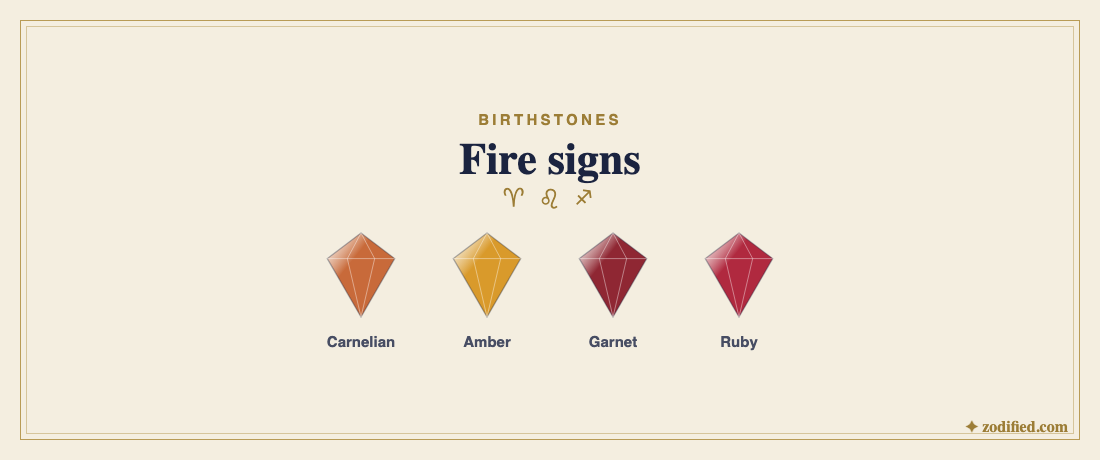
Aries (Mars) — carnelian, red jasper, garnet, ruby, diamond. Warm, energetic stones that match an assertive character. Carnelian is traditionally associated with decisiveness and initiative, garnet with endurance, and ruby with leadership. Aries are usually advised to choose stones that "maintain the pace" rather than calm them down.
Leo (Sun) — amber, sunstone, heliodor, citrine, ruby. "Solar" gems for a sign that values brightness, warmth, and recognition. Amber has long been considered a stone of optimism and confidence, citrine of generosity and ease, and ruby of dignity.
Sagittarius (Jupiter) — turquoise, topaz, amethyst, sapphire, citrine. Stones of long journeys and a broad perspective. Turquoise was traditionally taken on travels as an amulet, topaz is linked to clarity of goals, and amethyst to moderation and a sober mind.
Earth Signs
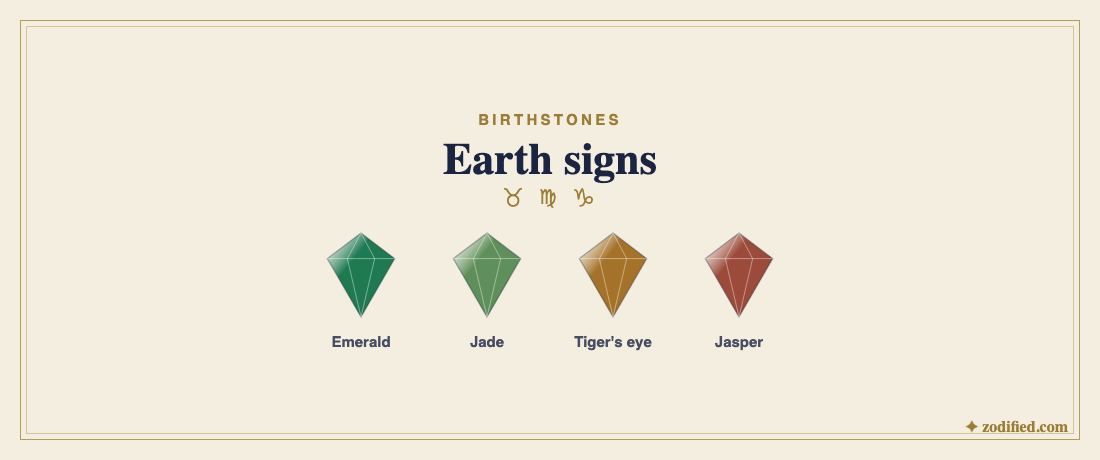
Taurus (Venus) — emerald, rose quartz, agate, sapphire, turquoise. Calm, "green," and soft stones for a practical and sensual sign. Emerald is linked to loyalty and stability, rose quartz to warmth in relationships, and agate to reliability.
Virgo (Mercury) — carnelian, jade, jasper, sapphire, agate. Stones of clarity and order, resonating with the analytical Virgo. Jade was traditionally considered a stone of moderation and health, sapphire of focus, and jasper of steadiness in affairs.
Capricorn (Saturn) — garnet, onyx, tiger's eye, smoky quartz, malachite. Dense, "grounding" stones for a goal-oriented sign. Onyx is linked to self-discipline and endurance, tiger's eye to sober decision-making, and garnet to perseverance.
Air Signs
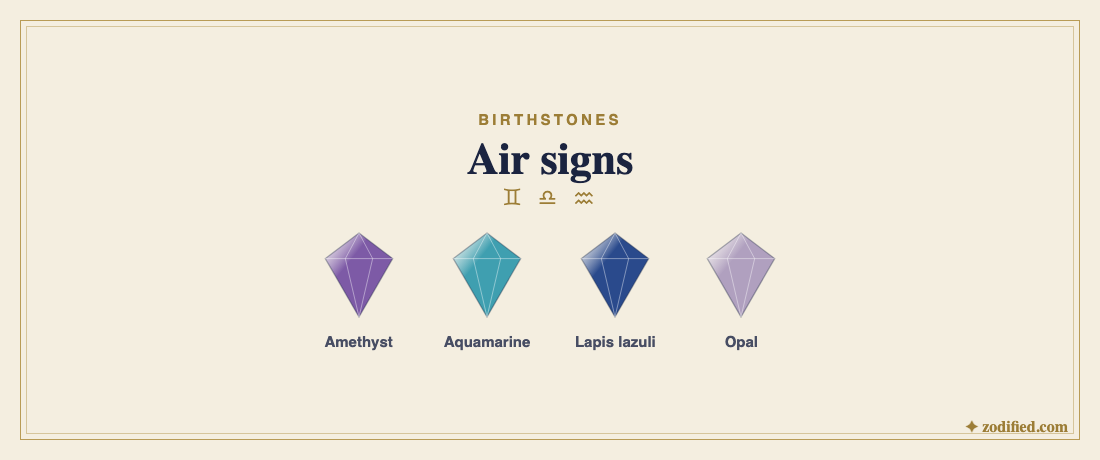
Gemini (Mercury) — agate, citrine, tiger's eye, pearl, topaz. Light and "talkative" stones for a sociable sign. Agate is traditionally linked to clarity in speech and focus, citrine to a light mood, and tiger's eye to attention to detail.
Libra (Venus) — opal, lapis lazuli, tourmaline, rose quartz, aquamarine. Stones of harmony and balance. Lapis lazuli was considered a stone of honesty and justice, opal of refined taste, and rose quartz of peace in relationships.
Aquarius (Uranus) — amethyst, aquamarine, labradorite, garnet, obsidian. Transparent and "unconventional" stones for an independent sign. Labradorite is prized for its play of light and originality, amethyst for clarity of thought, and aquamarine for a calm, free perspective.
Water Signs
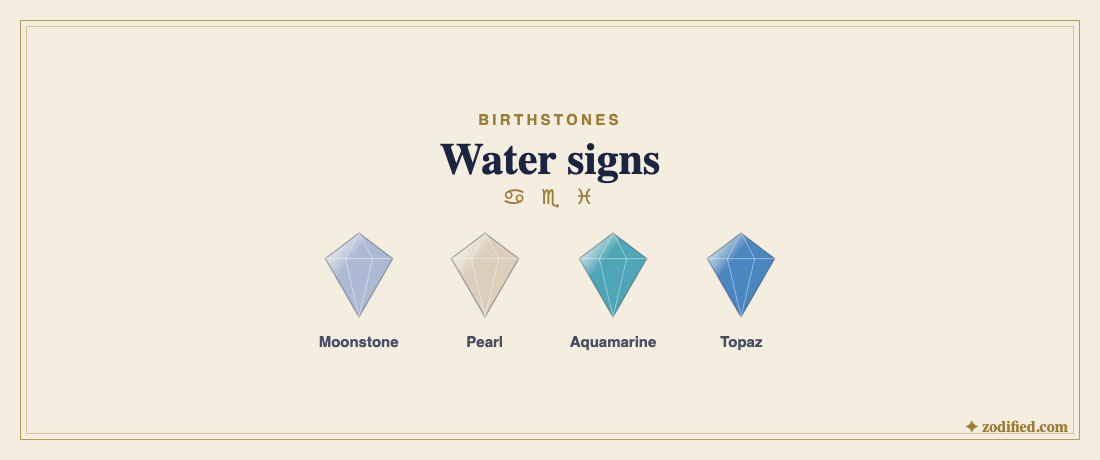
Cancer (Moon) — moonstone, pearl, emerald, ruby, selenite. Soft, "lunar" stones for a sensitive, home-loving sign. Moonstone is traditionally linked to intuition and calmness, pearl to warmth and care, and selenite to inner balance.
Scorpio (Pluto, Mars) — topaz, obsidian, garnet, malachite, aquamarine. Deep, saturated stones for a strong and passionate sign. Obsidian was considered a stone of protection and personal boundaries, garnet of passion and will, and malachite of emotional stability.
Pisces (Neptune, Jupiter) — aquamarine, amethyst, moonstone, pearl, fluorite. Transparent "watery" stones for a dreamy sign. Aquamarine is linked to peace and creative flow, amethyst to clarity amidst emotions, and fluorite to concentration.
Sign-Based Stones vs. Birth-Month Stones: They Are Different
People often confuse two systems:
- By Zodiac Sign — the stone is selected based on the sign's element and planet (as in the list above). One stone "works" for the entire period of the sign.
- By Birth Month (birthstone) — the stone is tied to a calendar month by jewelry tradition: for example, emerald for May, ruby for July, aquamarine for March. The borders of months and signs do not coincide, so a stone by date and a stone by sign may differ.
If you were born on the cusp of signs (the last or first days of a period), your personality often leans toward the neighboring sign—in that case, it makes sense to look at stones for both. There is no contradiction here: both systems are about tradition and personal meaning, not a precise "recipe."
How to Choose "Your" Stone
- Start with your sign's stone, but don't ignore your personal response. If you find a mineral visually unappealing, there's little point in such a "talisman"—you won't wear it.
- Define your goal. If you want focus, look at "grounding" stones; if you want warmth and lightness, look at "solar" ones. This is more about mood and associations than esotericism.
- Look at quality, not the legend. A natural stone with an honest description is better than a "charged amulet" with miraculous promises. Ask if the stone is natural or treated/synthetic—this directly affects price and care, but not "magic."
- Don't chase rarity. Agate, quartz, carnelian, and labradorite are accessible and beautiful stones; you don't need to overpay for an "exclusive" piece for a talisman.
How to Wear and Care For Them
- Wear them so the stone is with you: a ring, pendant, bracelet, earrings, or just a stone in your pocket. Tradition suggests contact with the skin, but this is not a strict rule—it's more important that you like the jewelry.
- Care for them simply. "Cleansing under running water," which is written about in esoteric texts, is essentially standard care: warm water, soft cloth. However, keep in mind: soft and porous stones (pearl, turquoise, malachite, opal) are sensitive to water, acids, and cosmetics—they should be wiped with a dry cloth.
- Protect from bumps and scratches. Stones have different levels of hardness: a diamond is almost impossible to scratch, but pearls or moonstone can be scratched easily.
Is It Worth Wearing a Birthstone at All?
The honest answer: yes—if you approach it sensibly. A birthstone is great because:
- it is beautiful and pleasant—it's more fun to wear jewelry with personal meaning than something random;
- it works as a reminder and mindset tool—looking at "your" stone makes it easier to gather your thoughts before an important task (psychologists call this the anchor effect);
- it is part of a culture that is interesting to explore.
What you shouldn't do: wait for miracles from the stone, treat illnesses with stones instead of a doctor, or overpay for "magical" properties. There are no proven esoteric effects for minerals—and a good seller will tell you this honestly. Buy a stone for its beauty, meaning, and quality, not for a promise to change your destiny.
In-depth guides: birthstones for each sign
Each sign has its own guide — which stones suit it and how to choose and wear them.
- Talisman Stones of Leo's: Unlocking Confidence and Radiance
- Talisman Stones for Aries' Success: Unlocking Inner Strength
- Lucky Stones of Taurus': Finding Balance and Harmony
- Talisman Stones for Gemini's: Enhancing Mercury's Gift
- Lucky Stones for Cancer's: Finding Emotional Balance
- Talisman Stones for Virgo's: Enhancing Practicality and Clarity
- Talisman Stones for Libra's Luck: Attracting Balance and Harmony
- Talisman Stones for Scorpio's: Unlocking Passion and Resilience
- Lucky Stones Sagittarius': Amplifying Jupiter's Fire
- Lucky Stones for Capricorn's: Unlocking Enduring Success
- Talisman Stones for Aquarius' Luck: Harnessing Celestial Balance
- Lucky Stones of Pisces: Unlocking Inner Strength
Frequently Asked Questions
Can I wear a stone from a "different" sign? Yes. There are no restrictions—focus on what you like and what suits you. Your sign's stone is a tradition, not a ban on the others.
Is there a universal stone for everyone? The closest to "universal" are clear quartz and its varieties: they are neutral, accessible, and pair well with any sign.
Is a synthetic stone bad? No, as long as you know what you are buying. A lab-grown stone is physically identical to a natural one and costs less. Its value as a "talisman" is a matter of your personal perspective, not its origin.
How can I tell if a stone is real? Ask for documentation and an honest description, buy from trusted sellers, and have expensive stones checked in a gemological laboratory. "Suspiciously cheap" usually means an imitation.
A birthstone is a beautiful tradition and a way to get to know your sign a little better, not a substitute for decisions and actions. If you want to dive deeper into your sign's character, visit its page: there you will find daily forecasts based on real ephemerides and a detailed analysis. And how exactly we calculate astrology is described honestly in our methodology section.